
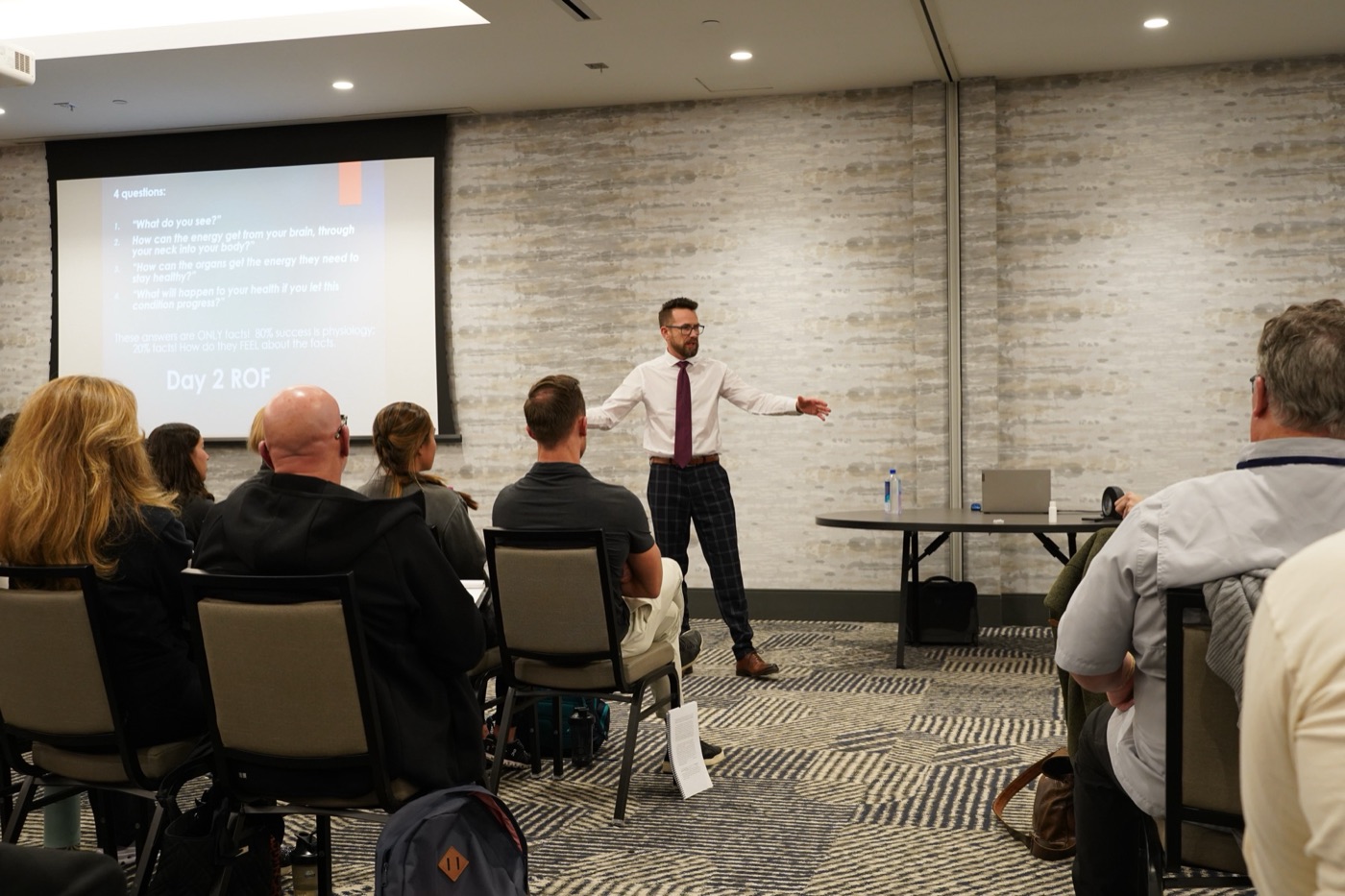
Most doctors walk into a report of findings hoping. Hoping the patient says yes. Hoping the spouse does not kill it. Hoping the number does not scare them off. Then they talk. They explain the X-rays, explain the plan, explain the fee, and they keep explaining until the patient says, “Let me think about it.”
Here is what I teach instead. The purpose of the ROF is NOT to sell them care. If you are talking a patient into care on Day 2, it is already too late. They should have picked you on Day 1.
So let’s start there.
Day 1 begins on the phone
The first person a new patient meets is not you. It is your front desk. On the phone, your team has no body language to lean on. The only tool you can use to create a “WOW” first impression is your tone. I tell front desk teams to sing the greeting, and to go straight to the referral source. “Jim sent you? Jim is a phenomenal patient.” That compliment is your first bit of common ground with a stranger. Everyone on the team repeats it: on the phone, at the front desk, and when you walk into the exam room.
Then comes the tour. The tour is not a walk past equipment. It is where the patient starts to feel your office is different from any office they have been in before.
The Patient Application Process
When your team hands a new patient the paperwork, they call it what it is: a Patient Application Form. And when the patient shows any curiosity, your team says one sentence: “We don’t accept every patient that walks in here.”
That one sentence changes the whole visit. It takes away the sales pitch they are expecting. Now they are not being sold. They are applying. They have steps to follow, and every step they take builds their commitment.
This is not a trick. It is the truth about corrective care. You can only help the people who follow the whole plan, so you only accept the people who are ready to.
Your measure on Day 1 is what they say
Most doctors grade themselves on what they said. Did I explain it well? Did I cover everything? That is the wrong test.
We don’t judge how effective we are by what WE say. We judge how effective we are by what THEY say.
Before a new patient leaves on Day 1, I want to hear three feelings from them, without anyone asking:
- “I’m in the right place.”
- “I have more problems than I thought.”
- “I hope the doctor can help me.”
Your front desk listens for these at checkout. If the patient does not say them, the front desk asks, “What did you learn about your condition today?” and tells you what they heard. If the answer is flat, you call that patient tonight. Your team works as one unit, front and back.
Tell them once, then ask a question
The communication rule in Elite is simple: tell them once, then ask a question. Every time you lecture, the patient stops listening. Every time you ask, they have to think, and they say it back to you in their own words. Your responsibility is to teach them how to think, not what to think. A patient who can explain their situation to their spouse is a patient who stays.
Day 2: the spouse is in the room
On Day 1, before the patient leaves, you ask for the spouse to come to Day 2 by first name. This matters more than any slide you show. Every health decision in a household belongs to both people. EVERY health problem is BOTH of their problems. When the spouse is in the room, the spouse can become your biggest supporter. When the spouse is at home, you get the most common line in chiropractic: “I have to talk to my husband.”
When the patient and spouse arrive, your front desk says, “It’s very important that you are here today.” It is not small talk. It tells them this visit matters.
In the report, you ask more than you tell. Both of them answer your questions. You are checking two things: do they understand what is going on, and are they ready to make a change right now? There are really only two decisions a person can make in that room. They decide to change their life now, or they decide their health is not a priority. Your job is to help them get clear on which one it is. Both are allowed. What you do not do is pretend a maybe is a yes.
The four requirements
If they are ready, you lay out the requirements to be accepted as a patient. In my system there are four: come in daily until the workshop, do the additional test we need, attend the new patient workshop with the spouse, and pay for all the services up to the workshop. Clear steps. No guessing.
Then you walk them to the front desk yourself and make a 3-way agreement: you, the patient and your front desk, out loud, with everyone nodding. If the patient changes any of it after you walk away, your front desk comes and gets you right away.
Why this works
Nothing here is pressure. It is the opposite. The patient knows what to expect at every step. The spouse is part of the decision. Your team knows its lines. And you stop carrying the whole conversation on your back.
Understand and adopt the mindset and the scripts will flow naturally. That is the order: mindset first, then words. At the New Patient and Report of Findings Bootcamp, we practice this out loud, with your team, until it feels natural.
Next step
Take the Free Practice Assessment
Ten questions. See how your new patient process scores, your two weakest areas, and the step that fits.
Next in the patient flow: Why patients quit care early, and the checkpoint system that keeps them. All articles: Articles. Elite Coaching provides business coaching, not medical care.